Standalone Activities - Go SDK
Temporal Go SDK support for Standalone Activities is at Pre-release.
All APIs are experimental and may be subject to backwards-incompatible changes.
Standalone Activities are Activity Executions that run independently, without being orchestrated by a Workflow. Instead
of starting an Activity from within a Workflow Definition using workflow.ExecuteActivity(), you start a Standalone
Activity directly from a Temporal Client using client.ExecuteActivity().
The Activity definition and Worker registration are identical to regular Activities, and only the execution path differs.
This page covers the following:
- Get Started with Standalone Activities
- Define your Activity
- Run a Worker with the Activity registered
- Execute a Standalone Activity
- Get the result of a Standalone Activity
- Get a handle to an existing Standalone Activity
- List Standalone Activities
- Count Standalone Activities
- Run Standalone Activities with Temporal Cloud
This documentation uses source code from the Go sample.
Get Started with Standalone Activities
Prerequisites:
-
Install the latest Temporal CLI
🚧 Please build from development branch: https://github.com/temporalio/cli/tree/release/v1.6.x-standalone-activity
-
Install the latest Temporal Go SDK (v1.40.0 or higher recommended)
All code samples on this page use
envconfig.MustLoadDefaultClientOptions()
to configure the Temporal Client connection. By default this connects to localhost:7233, but it
responds to environment variables and
TOML configuration files, so the same code works
against a local dev server and Temporal Cloud without changes. See
Run Standalone Activities with Temporal Cloud below.
The first step in running a Standalone Activity involves starting a Temporal server:
temporal server start-dev
This command automatically starts the Temporal development server with the Web UI, and creates the default Namespace.
It uses an in-memory database, so do not use it for real use cases.
The Temporal Server should now be available for client connections on localhost:7233, and the
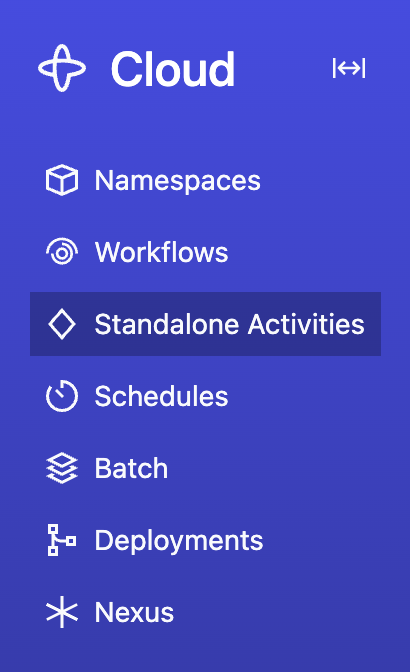
Temporal Web UI should now be accessible at http://localhost:8233. Standalone
Activities are available from the nav bar item located towards the top left of the page:
Clone the samples-go repository to follow along:
git clone https://github.com/temporalio/samples-go.git
cd samples-go
Define your Activity
Define your Activity in a shared file so that both the Worker and starter can reference it.
The sample project is structured as follows:
standalone-activity/helloworld/
├── activity.go
├── worker/
│   └── main.go
└── starter/
    └── main.go
standalone-activity/helloworld/activity.go
package helloworld

import (
	"context"
	"go.temporal.io/sdk/activity"
)

func Activity(ctx context.Context, name string) (string, error) {
	logger := activity.GetLogger(ctx)
	logger.Info("Activity", "name", name)
	return "Hello " + name + "!", nil
}
Run a Worker with the Activity registered
Running a Worker for Standalone Activities is the same as running a Worker for Workflow-driven Activities — you create a
Worker, register the Activity, and call Run(). The Worker doesn't need to know whether the Activity will be invoked
from a Workflow or as a Standalone Activity.
See How to develop a Worker in Go for more details on Worker setup and configuration options.
standalone-activity/helloworld/worker/main.go
package main

import (
	"github.com/temporalio/samples-go/standalone-activity/helloworld"
	"go.temporal.io/sdk/client"
	"go.temporal.io/sdk/contrib/envconfig"
	"go.temporal.io/sdk/worker"
	"log"
)

func main() {
	c, err := client.Dial(envconfig.MustLoadDefaultClientOptions())
	if err != nil {
		log.Fatalln("Unable to create client", err)
	}
	defer c.Close()

	w := worker.New(c, "standalone-activity-helloworld", worker.Options{})

	w.RegisterActivity(helloworld.Activity)

	err = w.Run(worker.InterruptCh())
	if err != nil {
		log.Fatalln("Unable to start worker", err)
	}
}
To run the Worker:
go run standalone-activity/helloworld/worker/main.go
Execute a Standalone Activity
Use client.ExecuteActivity() to start a Standalone Activity
Execution. This is called from application code (for example, a starter program), not from inside a Workflow Definition.
ExecuteActivity returns an ActivityHandle that you
can use to get the result, describe, cancel, or terminate the Activity.
The following starter program demonstrates how to execute a Standalone Activity, get its result, list activities, and count activities:
standalone-activity/helloworld/starter/main.go
package main

import (
	"context"
	"github.com/temporalio/samples-go/standalone-activity/helloworld"
	"go.temporal.io/sdk/client"
	"go.temporal.io/sdk/contrib/envconfig"
	"log"
	"time"
)

func main() {
	c, err := client.Dial(envconfig.MustLoadDefaultClientOptions())
	if err != nil {
		log.Fatalln("Unable to create client", err)
	}
	defer c.Close()

	activityOptions := client.StartActivityOptions{
		ID:        "standalone_activity_helloworld_ActivityID",
		TaskQueue: "standalone-activity-helloworld",
		ScheduleToCloseTimeout: 10 * time.Second,
	}

	handle, err := c.ExecuteActivity(context.Background(), activityOptions, helloworld.Activity, "Temporal")
	if err != nil {
		log.Fatalln("Unable to execute activity", err)
	}

	log.Println("Started standalone activity", "ActivityID", handle.GetID(), "RunID", handle.GetRunID())

	var result string
	err = handle.Get(context.Background(), &result)
	if err != nil {
		log.Fatalln("Unable get standalone activity result", err)
	}
	log.Println("Activity result:", result)

	resp, err := c.ListActivities(context.Background(), client.ListActivitiesOptions{
		Query: "TaskQueue = 'standalone-activity-helloworld'",
	})
	if err != nil {
		log.Fatalln("Unable to list activities", err)
	}

	log.Println("ListActivity results")
	for info, err := range resp.Results {
		if err != nil {
			log.Fatalln("Error iterating activities", err)
		}
		log.Printf("\tActivityID: %s, Type: %s, Status: %v\n",
			info.ActivityID, info.ActivityType, info.Status)
	}

	resp1, err := c.CountActivities(context.Background(), client.CountActivitiesOptions{
		Query: "TaskQueue = 'standalone-activity-helloworld'",
	})
	if err != nil {
		log.Fatalln("Unable to count activities", err)
	}

	log.Println("Total activities:", resp1.Count)
}
You can pass the Activity as either a function reference or a string Activity type name:
handle, err := c.ExecuteActivity(ctx, options, helloworld.Activity, "arg1")

// Using a string type name
handle, err := c.ExecuteActivity(ctx, options, "Activity", "arg1")
client.StartActivityOptions requires ID, TaskQueue, and at least one of ScheduleToCloseTimeout or
StartToCloseTimeout. See StartActivityOptions
in the API reference for the full set of options.
To run the starter (in a separate terminal from the Worker):
go run standalone-activity/helloworld/starter/main.go
Get the result of a Standalone Activity
Use ActivityHandle.Get() to block until the Activity completes and retrieve its result. This is analogous to calling
Get() on a WorkflowRun.
var result string
err = handle.Get(context.Background(), &result)
if err != nil {
	log.Fatalln("Activity failed", err)
}
log.Println("Activity result:", result)
If the Activity completed successfully, the result is deserialized into the provided pointer. If the Activity failed, the failure is returned as an error.
Get a handle to an existing Standalone Activity
Use client.GetActivityHandle() to create a handle to a previously started Standalone Activity. This is analogous to
client.GetWorkflow() for Workflow Executions.
Both ActivityID and RunID are required.
handle := c.GetActivityHandle(client.GetActivityHandleOptions{
	ActivityID: "my-standalone-activity-id",
	RunID:      "the-run-id",
})

// Use the handle to get the result, describe, cancel, or terminate
var result string
err := handle.Get(context.Background(), &result)
if err != nil {
	log.Fatalln("Unable to get activity result", err)
}
List Standalone Activities
Use client.ListActivities() to list Standalone Activity
Executions that match a List Filter query. The result contains an iterator that yields
ActivityExecutionInfo entries.
resp, err := c.ListActivities(context.Background(), client.ListActivitiesOptions{
	Query: "TaskQueue = 'standalone-activity-helloworld'",
})
if err != nil {
	log.Fatalln("Unable to list activities", err)
}

for info, err := range resp.Results {
	if err != nil {
		log.Fatalln("Error iterating activities", err)
	}
	log.Printf("ActivityID: %s, Type: %s, Status: %v\n",
		info.ActivityID, info.ActivityType, info.Status)
}
The Query field accepts the same List Filter syntax used for Workflow Visibility. For example,
"ActivityType = 'Activity' AND Status = 'Running'".
You can also list activities using the Temporal CLI:
temporal activity list
Count Standalone Activities
Use client.CountActivities() to count Standalone Activity
Executions that match a List Filter query.
resp, err := c.CountActivities(context.Background(), client.CountActivitiesOptions{
	Query: "TaskQueue = 'standalone-activity-helloworld'",
})
if err != nil {
	log.Fatalln("Unable to count activities", err)
}

log.Println("Total activities:", resp.Count)
Run Standalone Activities with Temporal Cloud
The code samples on this page use envconfig.MustLoadDefaultClientOptions(), so the same code
works against Temporal Cloud — just configure the connection via environment variables or a TOML
profile. No code changes are needed.
For full details on connecting to Temporal Cloud, including Namespace creation, certificate generation, and authentication options, see Connect to Temporal Cloud.
Connect with mTLS
export TEMPORAL_ADDRESS=<your-namespace>.<your-account-id>.tmprl.cloud:7233
export TEMPORAL_NAMESPACE=<your-namespace>.<your-account-id>
export TEMPORAL_TLS_CLIENT_CERT_PATH='path/to/your/client.pem'
export TEMPORAL_TLS_CLIENT_KEY_PATH='path/to/your/client.key'
Connect with an API key
export TEMPORAL_ADDRESS=<region>.<cloud_provider>.api.temporal.io:7233
export TEMPORAL_NAMESPACE=<your-namespace>.<your-account-id>
export TEMPORAL_API_KEY=<your-api-key>
Then run the Worker and starter code as shown in the earlier sections.